
Buying cat litter scoops wholesale requires more than comparing the lowest unit price. The daily litter-box routine is shaped by handle comfort, sieve spacing, material strength, and cleaning speed. These details become important when retailers serve apartment owners, multi-cat households, shelters, and grooming businesses.
The American Pet Products Association reported that 66% of U.S. households owned a pet in its 2023–2024 National Pet Owners Survey. Its data also showed substantial cat ownership across the country. Meanwhile, Grand View Research has identified steady growth in the global cat litter market. These reports do not measure scoop demand directly. That gap deserves attention. Still, expanding litter consumption supports a practical wholesale opportunity.
Pet industry analyst David Lummis has observed, “Retailers win when everyday pet products solve small problems consistently.” His point fits cat litter scoops wholesale. Buyers should inspect sample tools before placing a large order. Test a scoop beside a standard litter tray. Check whether wet clumps bend the edge. Examine the handle after repeated lifting. Small flaws become costly returns.
Wholesale planning should also compare stainless steel, reinforced plastic, packaging quality, and carton dimensions. A lower price may hide weaker mesh, sharper edges, or excessive shipping volume. Product claims need evidence, not attractive wording. Ask suppliers for material specifications, production photos, defect policies, and realistic lead times.
The right purchase is rarely the cheapest one. It is the one that performs reliably, fits the customer’s routine, and remains profitable after freight, storage, and returns. Mistakes happen. Careful testing reduces them.
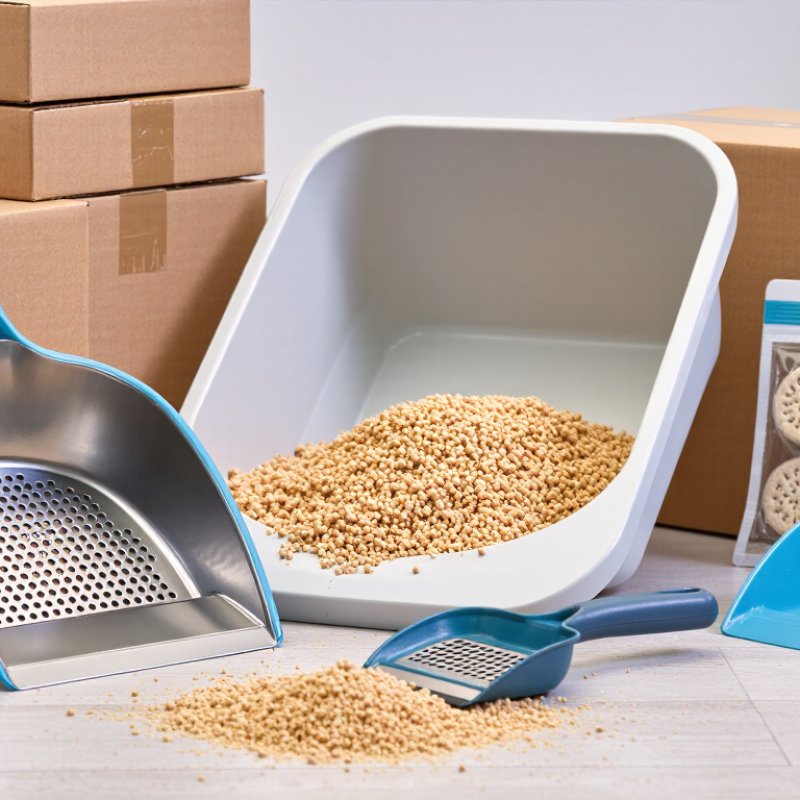
Before requesting wholesale quotes, define exactly how the cat litter scoop will be used. A scoop for clumping litter needs different openings from one used for fine litter. Record the expected daily volume, cleaning frequency, and user type. Home users may prefer lighter handles, while shelters need stronger tools. Small details matter.
Set measurable specifications for each part. Include scoop width, hole diameter, handle length, material, weight, and color range. Stainless steel offers durability, while reinforced plastic can reduce shipping weight. Check the handle connection carefully. It often fails before the scoop itself. Ask for load testing and clear quality tolerances. A sample is essential. Photos cannot show flexibility, rough edges, or uncomfortable grips. I once approved a low-cost tool that looked excellent but bent during repeated use. That mistake changed my purchasing checklist.
Define packaging and delivery requirements before discussing price. State the target order quantity, carton size, labeling needs, and acceptable defect rate. Request production samples from the same material and process used for the final order. Confirm inspection procedures, replacement terms, and production timelines in writing. Consider several price levels, but do not judge value by unit cost alone. Freight, damaged goods, and repacking can quickly change the calculation. Keep a written specification sheet, even if some details still need revision. That document supports consistent quotations and makes later corrections easier.
Buying cat litter scoops wholesale starts with careful supplier research, not a quick price search. Look for manufacturers or distributors with clear product specifications, stable communication, and verifiable business records. Request samples before placing a large order. Hold each scoop in your hand. Check the handle grip, edge thickness, joint strength, and whether the slots match the litter type you sell.
Compare more than unit prices. A low quote may exclude packaging, shipping, tooling, or inspection costs. Ask for the minimum order quantity, production timeline, payment terms, and replacement policy. Evaluate materials such as reinforced plastic, aluminum, or stainless steel based on durability and target customers. Some buyers prefer lightweight tools, while others expect a rigid scoop for heavy clumping litter. Small details matter.
Create a comparison sheet with columns for price, capacity, dimensions, color choices, carton quantity, and delivery estimate. Supplier responses should be specific, not vague promises. Ask for recent product photos and packaging measurements. You can also request a small trial order to test customer feedback. That assumption can fail. A scoop may look strong in pictures but bend during daily use. I would also compare several suppliers instead of trusting the first attractive offer. A slightly higher cost may reduce returns, yet only real testing can confirm that advantage.
When buying cat litter scoops wholesale, start with quality testing rather than unit price. APPA’s 2024 National Pet Owners Survey reports 49.6 million U.S. households own cats. That scale makes daily usability important. A scoop should remove wet clumps without bending, cracking, or trapping residue. Test samples with heavy, damp litter for one week. Check the handle joint, edge thickness, and slot spacing. Small defects become expensive returns.
Material affects durability and customer perception. Stainless steel resists rust and supports repeated cleaning, while polypropylene is lighter and usually more affordable. Recycled plastic can support sustainability goals, but suppliers should verify its consistency and odor performance. Grand View Research estimates the global cat litter market will expand at about 4.8% annually from 2024 to 2030. This growth supports demand for varied designs, not one universal scoop.
Design selection should match litter type and user habits. Narrow slots suit fine-grain litter; wider openings work better with larger pellets. Deep bowls reduce spills, while rubberized handles improve grip during repetitive use. Avoid sharp edges. Inspect ten pieces from each production batch, not just one sample. I have seen attractive scoops fail at the handle after limited use. That mistake is easy to overlook. A slightly higher purchase cost may be reasonable when testing confirms stronger materials, cleaner edges, and fewer replacement claims.
Wholesale cat litter scoops require more than checking the lowest unit price. A practical review should compare material, scoop size, handle strength, and packaging costs. Plastic scoops may cost less, while reinforced designs often withstand repeated warehouse handling. Ask suppliers for samples before placing a large order. A scoop that bends under a full load creates customer complaints and replacement expenses.
Pricing usually changes with quantity, customization, and shipping destination. Request a written quotation showing the unit price, tooling fees, carton dimensions, and payment schedule. Minimum order quantities may range from a few hundred pieces to several thousand. Smaller orders can carry higher prices. That is sometimes acceptable for testing demand. However, I have seen buyers ignore carton volume and lose their expected margin through freight charges. Check the landed cost, not only the factory price.
Shipping terms need equal attention. Confirm whether the quotation includes export packing, inland delivery, insurance, and customs-related charges. Compare sea, air, and rail options according to urgency and order size. Sea freight may reduce cost but requires longer planning. Request the estimated production time and shipping window in writing. Delivery dates can still move. Build a buffer of one or two weeks, especially before seasonal sales. Also inspect carton labels, moisture protection, and pallet stability before dispatch.
Wholesale cat litter scoops sell best when ordering matches real cleaning habits. The American Pet Products Association’s 2024 National Pet Owners Survey reports 49.6 million U.S. households own a cat. That large user base supports steady demand for practical, durable tools. Grand View Research estimates the global cat litter market could grow at a 4.8% compound annual rate from 2024 to 2030. Retailers should prepare for repeat purchases, not one seasonal shipment.
Place orders by carton, material, and handle design. Keep separate stock records for metal, plastic, and reinforced models. Record carton quantity, scoop dimensions, packaging space, and defect rates. A simple reorder point can prevent empty shelves: average weekly sales multiplied by supplier lead time, plus safety stock. For example, selling 40 scoops weekly with a four-week lead time requires at least 160 units before reordering. Add more when shipping delays are common.
Do not trust forecasts blindly. A slow-moving color can occupy valuable warehouse space for months. Review sales every two weeks and test smaller batches before increasing volume. Store scoops in dry cartons, away from crushed litter bags and sharp shelving. I would also inspect a sample from every shipment. One cracked handle can damage customer confidence. Inventory software helps, but inaccurate counting still creates expensive mistakes. Keep the process visible, practical, and slightly conservative.
| Product Type | Material | Typical Use | Approx. Length | Pack Size | Suggested MOQ | Indicative Unit Cost Range (USD) | Standard Lead Time | Reorder Point | Inventory Status |
|---|---|---|---|---|---|---|---|---|---|
| Standard Slotted Scoop | Polypropylene | Clumping litter and daily tray cleaning | 13 in | 48 units/carton | 240 units | $0.55–$0.95 | 15–25 days | 120 units | Ready to Order |
| Deep-Bowl Scoop | Polypropylene | Large-volume litter removal | 14 in | 36 units/carton | 180 units | $0.85–$1.35 | 18–28 days | 90 units | Ready to Order |
| Fine-Slot Scoop | Polypropylene | Small clumps and fine-grain litter | 12.5 in | 48 units/carton | 240 units | $0.60–$1.05 | 15–25 days | 120 units | Check Forecast |
| Aluminum Scoop | Aluminum alloy | Heavy-duty use and multi-cat households | 15 in | 24 units/carton | 120 units | $2.20–$4.00 | 25–40 days | 60 units | Check Forecast |
| Long-Handle Scoop | Polypropylene and aluminum | Reduced bending during cleaning | 28 in | 20 units/carton | 100 units | $3.00–$5.50 | 25–40 days | 50 units | Low Stock |
| Wall-Mounted Scoop Set | Polypropylene and ABS | Retail display and organized storage | 13 in | 24 sets/carton | 120 sets | $2.50–$4.50 | 20–35 days | 48 sets | Ready to Order |
| Ordering note: Confirm material, dimensions, packaging, minimum order quantity, shipping terms, and final quotation before placing a wholesale purchase order. Reorder points should be adjusted according to sales velocity and supplier lead time. | |||||||||
Test samples with heavy, damp litter for one week. Check bending, cracks, residue, handle joints, and edge thickness. Small defects become costly returns.
Stainless steel resists rust and repeated cleaning. Polypropylene is lighter and often less expensive. Recycled plastic may support sustainability goals, but consistency and odor performance need verification.
Narrow slots suit fine-grain litter. Wider openings handle larger pellets better. Deep bowls reduce spills, while textured handles improve grip during repeated cleaning.
Inspect at least ten pieces from every batch. Check handle strength, slot spacing, sharp edges, and surface defects. One sample is not enough.
Compare the landed cost, not only the factory price. Include unit prices, tooling, packaging, carton space, inland delivery, insurance, and shipping charges. Freight is easy to underestimate.
Request a smaller batch when testing demand. Larger orders may lower unit prices, but slow-moving colors can fill storage space. My forecast could be wrong, so test carefully.
Request production time and shipping windows in writing. Compare sea, air, and rail options. Add a one- or two-week buffer before seasonal sales.
Multiply average weekly sales by supplier lead time, then add safety stock. Selling 40 scoops weekly with four weeks’ lead time requires 160 units before reordering. Keep extra stock when delays are common.
Keep cartons dry and away from sharp shelving. Record material, handle design, dimensions, carton quantity, and defect rates. Inspect a sample from every shipment. Counting errors still happen.
Buying cat litter scoops wholesale requires a clear plan from product selection to inventory management. Start by defining your needs, including scoop size, quantity, intended customers, packaging, and preferred features. Then research multiple suppliers and compare their product ranges, customization options, production capacity, and communication standards. Evaluate scoop quality carefully by checking materials, durability, handle comfort, mesh design, and suitability for different types of cat litter. A reliable product should be practical, easy to clean, and strong enough for regular use.
Before placing an order, review unit pricing, minimum order quantities, payment conditions, lead times, and shipping terms. Request samples when possible to confirm quality before making a larger commitment. After choosing a supplier, place the order with accurate specifications and keep detailed records of delivery schedules and costs. Effective inventory management will help prevent overstocking, avoid shortages, and support consistent customer service when purchasing Cat litter scoops wholesale.