
T: +48 (32) 259 93 03 [email protected] Made in Katowice, Poland — EU
0%

For global buyers, choosing reliable Plastic cat litter boxes from China requires more than comparing prices. Product design, material quality, factory experience, and shipment reliability all influence the final buying decision. A box may look practical in photos, yet feel unstable when filled with heavy litter. Small details matter.

This guide examines leading Chinese suppliers through a buyer-focused lens. It considers polypropylene quality, wall thickness, ventilation, entry height, rim design, and cleaning convenience. Real purchasing experience shows that smooth interiors usually reduce residue and simplify daily washing. Stackable shapes can also lower warehouse space and shipping costs. However, “best” does not mean identical for every market. A compact model may suit apartments, while a larger enclosed box may serve multi-cat households better.

Reliable suppliers should provide clear specifications, product samples, inspection support, and consistent communication. Buyers should verify dimensions, color accuracy, packaging strength, and odor-related design claims before placing large orders. Factory audits and sample testing add useful evidence. Certifications and export documentation should also be reviewed for the destination market.

Some decisions remain less obvious. A cheaper unit can become expensive after breakage, returns, or weak packaging. I have found that attractive features sometimes complicate cleaning. That deserves reflection. This overview does not treat supplier rankings as permanent facts. Manufacturing capacity, materials, and service quality can change. Careful comparison, direct questions, and practical testing remain essential for selecting Plastic cat litter boxes with confidence.
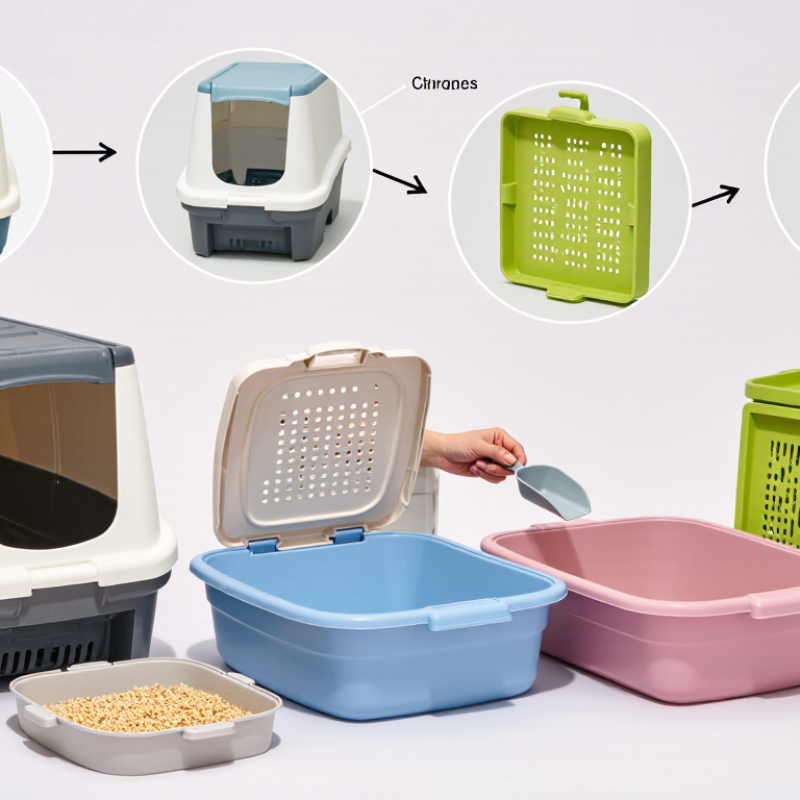
China Top Plastic Cat Litter Boxes for Global Buyers?

Global Demand Snapshot: 46.5 Million U.S. Cat Households (APPA 2023–24)

The U.S. alone has 46.5 million cat-owning households, according to the APPA 2023–2024 National Pet Owners Survey. That figure signals steady demand for practical litter equipment. It also raises expectations for hygiene, durability, and easy cleaning. Plastic litter boxes remain attractive because they are lightweight, stackable, and cost-efficient for international shipping. Small details matter. A smooth interior helps reduce residue buildup. Higher sidewalls can limit scattered litter, especially in compact apartments.

Global buyers should examine more than unit price. Grand View Research identifies hygiene, odor control, and household convenience as important drivers in the cat litter market. During procurement, check plastic thickness, rim strength, surface finish, and packaging protection. Recycled-content options may support sustainability goals, but material consistency still requires testing. This is where many specifications become vague. A box can look sturdy in photographs and flex during warehouse handling. Request sample inspections, load checks, dimensional tolerances, and cleaning simulations before placing large orders. APPA’s household data is U.S.-focused, not a complete global forecast. Still, it offers a reliable demand reference for exporters planning capacity, colors, sizes, and private-label packaging without using brand names.

Size Standards: AAFP/ISFM Recommend Boxes at Least 1.5× Cat Length

China Top Plastic Cat Litter Boxes for Global Buyers?

Size Standards: AAFP/ISFM Recommend Boxes at Least 1.5× Cat Length

For global buyers, size should guide every plastic litter box decision. AAFP and ISFM environmental guidelines recommend a box measuring at least 1.5 times the cat’s body length. Measure from the nose to the base of the tail. Do not include the tail tip. A 45-centimeter cat therefore needs a box at least 67.5 centimeters long. Many kittens outgrow standard boxes faster than expected.

Space changes behavior. A cat needs room to enter, turn, dig, and leave without touching the walls. Older cats may also need a lower entrance, while larger cats require wider interiors. The 1.5× rule is a starting point, not a finish line. In practical testing, oversized boxes often reduce scattered litter around the tray. That detail is easy to miss.

The American Pet Products Association’s 2024–2025 National Pet Owners Survey reports about 49.6 million U.S. households own cats. This large consumer base increases demand for durable, easy-clean plastic designs. Buyers should check internal dimensions, not only external packaging dimensions. Rounded corners can simplify washing, but sharp seams may trap odor and moisture. A washable, rigid box sounds ideal. Yet excessive thickness can increase shipping weight and cost. Manufacturers and importers should validate dimensions with adult cats, not showroom samples. Industry guidelines help, but real cats remain unpredictable.

Material Selection: PP vs. HDPE and 30%+ Recycled-Content Options

For global buyers, plastic cat litter box material affects durability, weight, cleaning, and shipping cost. Polypropylene, or PP, is lightweight and resists moisture, household cleaners, and repeated washing. Its slightly flexible structure helps reduce cracking around rims and clips. PP works well for stackable boxes, removable lids, and molded ventilation panels.

High-density polyethylene, or HDPE, offers stronger impact resistance, especially in colder warehouses or during rough transport. It feels tougher under pressure but may require thicker walls. That can increase weight and freight costs. In practical inspections, I check corner deformation, handle strength, and lid alignment after repeated loading. A box can look excellent but still fail at the hinge.

Recycled-content options deserve careful verification. Products containing 30% or more recycled plastic can reduce dependence on virgin resin, but color, odor, and surface consistency may vary. Darker colors often hide these differences. They should not hide quality issues. Buyers should request recycled-content records, batch information, odor testing, and impact results. A stable blend of recycled and virgin material may perform better than a higher percentage with poor consistency. This is where specifications sometimes need revision. A target percentage alone does not prove reliable performance. Samples should be tested after washing, stacking, and exposure to temperature changes.

China Top Plastic Cat Litter Boxes for Global Buyers? - Material Selection: PP vs. HDPE and 30%+ Recycled-Content Options
Evaluation Dimension PP — Polypropylene HDPE — High-Density Polyethylene 30%+ Recycled-Content Option
Typical material structure Homopolymer or copolymer PP; suitable for molded litter trays, lids, scoops, and clips. Injection-molding or blow-molding grade HDPE; suitable for durable trays, containers, and reinforced components. Recycled PP or recycled HDPE blended with virgin resin, commonly supported by stabilizers and color masterbatch.
Density Approximately 0.90–0.91 g/cm³, giving a low-weight product. Approximately 0.94–0.97 g/cm³, generally heavier than PP at the same volume. Usually close to the selected base resin, although fillers, pigments, and contamination can increase variation.
Approximate melting range About 160–170°C, depending on grade and copolymer content. About 125–135°C, depending on grade and molecular structure. Processing temperature should follow the actual recycled-resin specification; filtration and moisture control may be required.
Stiffness and shape retention Good stiffness-to-weight ratio; effective for lightweight trays with ribs or thickened edges. Good toughness and rigidity; useful where impact resistance and robust walls are priorities. Can be slightly less consistent than virgin resin; product design should include adequate wall thickness and reinforcing ribs.
Impact resistance Good overall impact performance; impact-copolymer PP improves resistance, especially at lower temperatures. Very good impact resistance, including strong resistance to cracking during handling and transport. Performance depends on recycled-feedstock quality, polymer degradation, and the percentage of virgin resin added.
Flexibility and hinge performance Good living-hinge performance and moderate flexibility; useful for foldable or snap-fit lids. More flexible and less rigid in thin sections; suitable for durable parts but less ideal for repeated thin living hinges. Repeated flexing should be validated because recycled resin may have reduced molecular weight and lower fatigue consistency.
Chemical and moisture resistance Very good resistance to water, dilute acids, alkalis, and many household chemicals. Very good moisture and chemical resistance; suitable for contact with wet litter and routine cleaning agents. Resistance is generally similar to the base polymer, but contaminants and mixed-polymer content must be controlled.
Typical operating temperature for use Commonly suitable for normal indoor and outdoor handling temperatures; prolonged heat exposure should be tested. Suitable for normal indoor and outdoor handling temperatures; prolonged heat can cause distortion or creep. Thermal performance may be less predictable; validation should include hot-water cleaning and warehouse-temperature testing.
Surface appearance Can provide a smooth, glossy, or textured finish with good color flexibility. Usually provides a smooth to semi-gloss finish with a slightly softer visual appearance than PP. May show subtle color variation, speckling, flow marks, or a less uniform surface unless filtered and color-matched carefully.
Odor and cleanliness considerations Virgin PP is typically low-odor when properly processed; recycled grades require source and odor screening. Virgin HDPE is typically low-odor when properly processed; recycled grades require contamination and odor controls. Odor and contamination control is critical, especially for indoor pet products used near living areas.
Recommended recycled-content range Common commercial options include 30%–50% recycled PP, subject to color, odor, and mechanical-property requirements. Common commercial options include 30%–100% recycled HDPE for suitable non-food-contact applications, subject to specification and testing. 30%+ recycled content can be specified by mass, with the exact percentage verified through supplier documentation or chain-of-custody records.
Color options Wide color range, including custom colors; recycled content may require darker or earth-tone shades for better consistency. Wide color range; recycled HDPE commonly performs well in dark, neutral, and natural colors. Dark gray, black, brown, green, and other muted colors generally conceal recycled-resin variation better than bright colors.
Manufacturing suitability Well suited to injection molding, thin-wall molding, snap fits, and integrated ribs. Well suited to injection molding and blow molding; supports durable thick-wall designs. Requires tighter control of melt filtration, drying where applicable, melt flow, and batch-to-batch quality.
Approximate shrinkage consideration Often around 1.0%–2.5%, depending on grade, wall thickness, mold design, and processing conditions. Often around 1.5%–3.0%, depending on grade, wall thickness, mold design, and processing conditions. Recycled content can alter shrinkage and warpage; production tooling should be confirmed using the selected resin grade.
Weight and freight impact Lower resin density can reduce part weight when equivalent strength is achieved through design. Higher density may increase part weight, but durable designs can reduce replacement and damage risk. May reduce virgin-plastic demand and support sustainability targets without necessarily changing product weight.
Best fit for global buyers Lightweight, colorful, easy-to-clean litter boxes requiring stiffness, snap-fit features, or efficient shipping. Heavy-duty litter boxes requiring strong impact resistance, robust walls, and long service life. Projects prioritizing recycled-material claims, lower virgin-resin use, and documented sustainability requirements.
Key quality checks before mass production Drop test, load test, lid-fit test, chemical-cleaning test, color consistency, and dimensional stability. Drop test, wall-impact test, load test, odor check, cleaning-agent compatibility, and dimensional stability. Verify recycled-content percentage, origin, odor, contamination, melt-flow range, tensile/impact performance, and color consistency.
Overall selection guidance Choose PP when low weight, stiffness, color flexibility, and snap-fit design are key priorities. Choose HDPE when toughness, impact resistance, and robust handling performance are the main priorities. Choose 30%+ recycled content when sustainability targets are important and the buyer accepts additional validation for appearance and consistency.
Notes: Values are typical industry ranges for general-purpose molding grades and are provided for preliminary material selection only. Actual performance depends on resin grade, recycled-feedstock quality, additives, mold design, wall thickness, processing conditions, and product testing. Recycled-content percentages should be confirmed by supplier documentation and applicable market requirements.

Supplier Verification: ISO 9001 Audits, MOQ, Lead Times, and QC Defects

China Top Plastic Cat Litter Boxes for Global Buyers?

Global pet demand makes supplier screening more important. APPA’s 2024 State of the Industry report valued U.S. pet spending at about $152 billion. This growth attracts many plastic manufacturers, but sales volume does not prove factory reliability. An ISO 9001 certificate is useful evidence, not a guarantee. The ISO Survey 2022 recorded more than 1.2 million ISO 9001 certificates worldwide. Buyers should verify the certificate number, production-site address, scope, expiry date, and recent surveillance audit.

Ask for process records, not only polished documents. A capable supplier should explain resin grades, mold maintenance, incoming inspection, and final sampling. ISO 2859-1 can support an agreed acceptance plan.

For litter boxes, inspect rim warping, sharp flash, pinholes, weak handles, poor nesting, and unpleasant plastic odor. Drop tests and carton-compression checks matter. Small defects become expensive after ocean freight.

MOQ and lead times need written conditions. A low MOQ may increase unit cost or reduce color choices. Confirm tooling ownership, sample approval, production capacity, and holiday shutdown dates. A practical plan might separate sample approval from mass production. Many suppliers quote 15 to 25 working days, yet this can exclude molding queues and packaging delays. I would also require pre-shipment photos and an independent inspection. Still, inspection is not perfect. Sampling can miss hidden cracks, and I have seen acceptable samples followed by weaker production batches. Conditional payment and batch traceability provide useful pressure.

Export Compliance: REACH, CPSIA, EN 71, and HS Code 3924 Requirements

China Top Plastic Cat Litter Boxes for Global Buyers?

Export compliance starts with material evidence, not a supplier’s verbal assurance. The EU Safety Gate 2023 report recorded 3,412 alerts and 4,287 follow-up actions. ECHA’s 2023 enforcement project inspected 2,407 products and found 18% non-compliant. These figures make REACH screening practical, not decorative. Request polymer specifications, pigment details, recycled-content records, and laboratory tests for SVHCs and restricted substances. Check each component, including hinges, rubber feet, coatings, and odor-control inserts. A declaration without batch traceability remains weak.

HS Code 3924 often covers household articles made from plastics, and many litter boxes may fit this category. However, classification depends on construction, use, and importing-country customs practice. Ask a licensed broker to confirm the tariff line before shipment. Keep the ruling, commercial invoice, packing list, product photos, and dimensions together. CPSIA usually concerns children’s products, so a standard pet litter box is not automatically a children’s article. Child-directed packaging can change the risk assessment. Test for lead and phthalates when the intended market or product design requires it.

EN 71 applies when the item is marketed as a toy or includes toy-like functions. It is not a universal pet-product certificate. Use an accredited laboratory and identify the exact test edition. One weakness deserves attention: suppliers sometimes test only the box, ignoring accessories. That shortcut can fail. A small painted scoop may create the larger compliance problem.

China Top Plastic Cat Litter Boxes for Global Buyers

Export Compliance: REACH, CPSIA, EN 71, and HS Code 3924 Requirements

REACH

The 0.1% reference point equals 1,000 ppm for SVHC communication obligations in articles. It is not a universal product-ban limit.

CPSIA

For applicable children's products, CPSIA sets a 90 ppm lead limit for surface coatings and a 0.1% limit for specified phthalates.

EN 71

EN 71 is a toy-safety series. It generally becomes relevant only when a cat litter box is marketed, packaged, or reasonably used as a toy.

HS Code 3924

HS heading 3924 covers plastic tableware, kitchenware, household articles, and hygienic or toilet articles. The final tariff subheading depends on customs classification.

The chart compares published concentration reference points only. Product classification, intended use, destination-market rules, testing, labeling, and documentation should be confirmed before export.

FAQS

Why is demand for plastic cat litter boxes growing?

Millions of U.S. households own cats, creating steady demand for practical litter equipment. Buyers expect hygiene, durability, and easy cleaning.

What size should a cat litter box be?

A useful guideline is at least 1.5 times the cat’s body length. Measure from the nose to the tail base. Exclude the tail tip.

How much space does a cat need inside the box?

The cat should enter, turn, dig, and leave without touching the walls. Larger cats may need wider interiors. Oversized boxes can reduce scattered litter.

Should buyers check internal or external dimensions?

Check internal dimensions first. Packaging measurements can look generous but hide a cramped interior. Test boxes with adult cats when possible.

Which plastic is suitable for litter boxes?

Polypropylene is lightweight, moisture-resistant, and suitable for repeated washing. High-density polyethylene offers stronger impact resistance during cold storage or rough transport.

What should buyers inspect beyond the material type?

Inspect plastic thickness, rim strength, corners, seams, handles, and lid alignment. A box may look strong yet flex during warehouse handling.

Are recycled-content plastic boxes reliable?

They can be reliable when batches remain consistent. Request recycled-content records, odor testing, impact results, and surface checks.

What problems can recycled plastic create?

Color, odor, and surface consistency may vary. Dark colors can hide defects. They should not hide quality problems.

How can packaging and shipping costs be controlled?

Lightweight, stackable boxes usually reduce freight pressure. Excessive wall thickness adds weight. Test stacking before ordering large quantities.

What testing should happen before a large purchase?

Request samples, load checks, dimensional tolerances, washing simulations, and temperature-change testing. Specifications sometimes need revision. Photos are not enough.

Conclusion

China is a major sourcing destination for plastic cat litter boxes, offering global buyers a broad range of sizes, materials, and customization options. With approximately 46.5 million U.S. households owning cats according to the APPA 2023–24 data, demand continues to grow for durable, hygienic, and easy-to-clean products. Buyers should select boxes that meet AAFP and ISFM guidance, ideally providing an interior length of at least 1.5 times the cat’s body length. Polypropylene (PP) and high-density polyethylene (HDPE) are common material choices, while options containing 30% or more recycled content may support sustainability goals when properly tested.

Before placing an order, importers should verify supplier capabilities through ISO 9001-based audits, clear minimum order quantities, realistic lead times, and documented quality-control procedures covering defects such as cracks, deformation, sharp edges, and poor molding. Export planning should also address applicable REACH, CPSIA, and EN 71 requirements, along with the appropriate HS Code 3924 classification. Consistent documentation and pre-shipment inspection can help reduce compliance risks and improve supply reliability.

Ethan Carter

Ethan Carter

Ethan Carter is a professional marketing specialist and a trusted voice behind the company’s expert blog. With a strong understanding of market strategy, customer needs, and product applications, he transforms complex information into clear, practical, and engaging content for business readers.......