T: +48 (32) 259 93 03 [email protected] Made in Katowice, Poland — EU
0%

Sourcing Corner-fit pet feeding bowls requires more than finding a bowl that fits neatly into a room’s angle. The product must support comfortable eating, reliable hygiene, and consistent manufacturing. A narrow kitchen corner may save space, but it can also restrict a pet’s shoulder movement or make cleaning awkward. Small details matter.

A useful perspective comes from Alyssa Hart, a pet-product sourcing specialist with experience in feeding accessories. She says, “A successful corner bowl must fit the pet first, and the corner second.” That principle should guide every supplier conversation. Ask for precise dimensions, internal depth, rim height, base stability, and material specifications. Stainless steel, food-grade silicone, and durable ceramic each have different strengths. Samples should be checked for sharp edges, unstable feet, trapped food, and unpleasant odors. They should also be tested on real surfaces, not only photographed on a factory table.

Supplier reliability deserves equal attention. Review production records, quality-control procedures, packaging strength, and sample consistency. Request food-contact documentation where applicable. Confirm whether the bowl remains stable during enthusiastic eating. A clever triangular shape is not enough. It may still slide across polished tile.

I would not assume the first sample is ready for sale. Fit can look perfect on paper and fail beside a skirting board. Some prototypes also collect crumbs in their rear corner. That flaw is easy to miss. A careful sourcing process includes revisions, independent inspection, and feedback from pet owners. The best Corner-fit pet feeding bowls combine efficient space use with comfort, cleanliness, and dependable everyday performance.

How to Source Corner Fit Pet Feeding Bowls?

Understanding Corner-Fit Pet Feeding Bowls and Their Benefits

How to Source Corner Fit Pet Feeding Bowls?

Corner-fit pet feeding bowls use unused floor space near walls or cabinet edges. Their triangular or quarter-round shape can reduce walking obstruction in small kitchens. This matters as pet ownership expands. The American Pet Products Association’s 2023–2024 National Pet Owners Survey reports that 66% of U.S. households own a pet, representing about 86.9 million homes. More pets often mean tighter feeding areas.

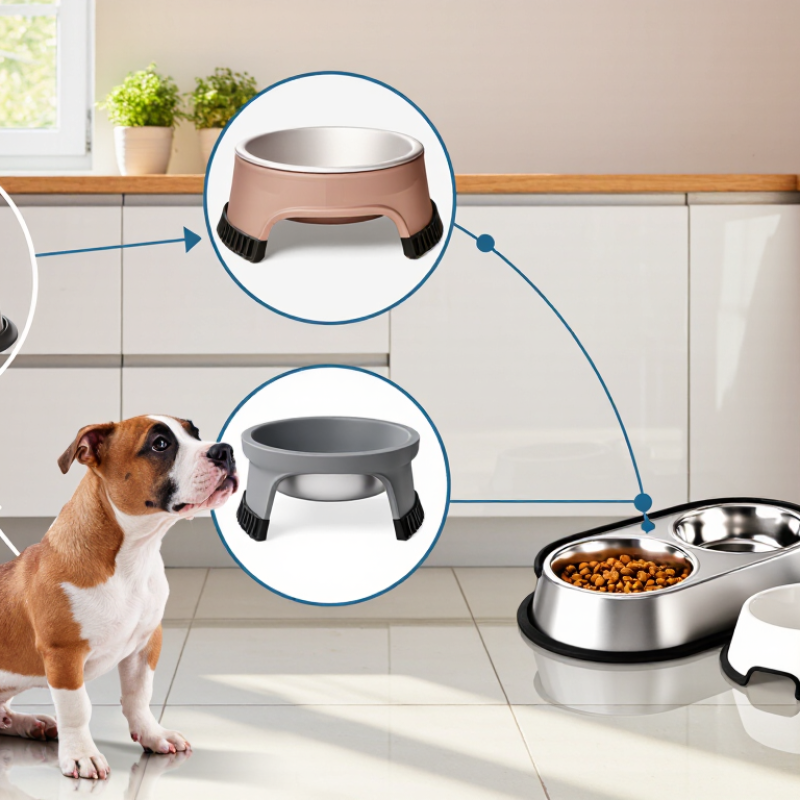
Source bowls with measured dimensions, not attractive photos alone. Leave enough clearance for a dog’s muzzle or a cat’s whiskers. Stainless steel inner surfaces are practical because they resist odors and are easier to inspect. A removable silicone base can reduce sliding and spilled water. Look for rounded seams, stable weight, and dishwasher-safe parts. The CDC advises regular cleaning of pet food and water bowls, especially after wet food use.

Small details matter. Very small.

Euromonitor International’s 2024 pet-care consumer research highlights convenience and hygiene as important ownership concerns. A corner bowl can support both, but it is not automatically more hygienic. Dust may collect where two walls meet. I would request material test reports, food-contact declarations, load testing, and clear washing instructions from suppliers. One weakness remains: a fixed corner design may fit one room perfectly and fail in another. Measure twice. Test with water before ordering large quantities. Personal observation also matters; some anxious pets dislike bowls touching walls.

How to Source Corner Fit Pet Feeding Bowls? Understanding Corner-Fit Pet Feeding Bowls and Their Benefits
Product Dimension Typical Specification or Data Why It Matters for Corner-Fit Bowls Sourcing and Quality Check
Corner Geometry A rear angle of approximately 90° is the most common configuration for fitting into room corners. Allows the feeder to sit closely against two adjoining walls and helps reduce wasted floor space. Request a dimensional drawing showing the rear angle, front width, side depth, and overall height.
Overall Width Common compact-to-large designs measure approximately 25–45 cm across the front. A wider front can support larger bowls but may reduce walking clearance in narrow areas. Compare the product width with the intended placement area and verify tolerances before production.
Side Depth Typical side depth is approximately 18–35 cm from the corner toward the front edge. Depth determines how far the feeder projects into the room and how much food or water capacity it can hold. Measure the available corner depth, including skirting boards, wall trim, and nearby furniture.
Bowl Capacity Common individual bowl capacities range from approximately 350 ml to 1,500 ml. Smaller capacities suit cats and small dogs, while larger capacities are more appropriate for medium and large dogs. Confirm usable capacity rather than outer volume, and request fill-level photographs or test measurements.
Recommended Pet Size Compact models are generally suitable for cats and small dogs; larger models may accommodate medium or large dogs. The bowl opening, capacity, and feeding height should match the animal’s muzzle size and daily intake. Specify target pet weight ranges and request bowl-opening dimensions for compatibility testing.
Bowl Opening Diameter Typical removable bowl openings measure approximately 12–24 cm in diameter, depending on capacity. A sufficient opening helps pets access food comfortably and makes cleaning easier. Check the internal opening, rim thickness, and clearance from the feeder frame to prevent restricted access.
Stainless Steel Bowl Food-contact bowls are commonly specified in stainless steel, often using grades such as 304 for corrosion resistance. Stainless steel is durable, non-porous, and generally easy to wash when properly finished. Ask for the declared steel grade, food-contact documentation, weld-quality details, and surface-finish standard.
Ceramic Bowl Ceramic bowls are typically heavier than metal bowls and may use a glazed food-contact surface. The extra weight can improve stability, while the glaze provides a smooth surface for cleaning. Check glaze consistency, edge smoothness, crack resistance, and food-contact compliance documentation.
Silicone Components Food-grade silicone may be used for anti-slip feet, bowl holders, or removable liners. Flexible silicone can reduce sliding and cushion contact between the feeder and the floor. Confirm that silicone parts are securely fitted, odor-free, easy to remove, and suitable for repeated washing.
Feeding Height Floor-level corner bowls commonly have a low profile; raised designs may elevate the bowl by approximately 8–20 cm. Height affects posture, accessibility, stability, and suitability for different pets. Offer clear height options and confirm that the bowl remains stable when the pet pushes against it.
Anti-Slip Stability Non-slip feet, rubber pads, silicone rings, or a weighted base are common stability solutions. Stable placement helps reduce spills, sliding, and noise during feeding. Perform a push test on tile, wood, and other common floor surfaces using a filled bowl.
Spill Control Raised rims, recessed bowls, and surrounding splash guards are commonly used to contain food and water. Corner placement can make cleaning more difficult, so spill containment is especially useful. Test with both dry food and water, checking overflow, drainage, and access to cleaning areas.
Removability Removable bowls are generally preferred for daily washing and refilling. Separate bowls improve hygiene and make it easier to clean the feeder base and surrounding floor. Check removal force, handle clearance, replacement availability, and whether the bowl rattles in its holder.
Cleaning Requirements Smooth, non-porous surfaces with minimal seams are easier to clean than textured or highly jointed surfaces. Reduced residue buildup supports better routine hygiene and lowers maintenance effort. Review cleaning instructions and test repeated washing for staining, odor retention, rust, or finish damage.
Wall Clearance A small clearance may be required when walls have baseboards, trim, outlets, or uneven surfaces. Insufficient clearance can prevent the rear edges from sitting flush in the corner. Request rear-profile drawings and verify the design against common baseboard and wall-trim dimensions.
Material Safety All food-contact surfaces should be made from materials intended for repeated contact with pet food and water. Material safety is essential because bowls may remain wet or hold food for extended periods. Request material declarations, migration or food-contact test reports, and documentation for coatings and dyes.
Packaging Protection Protective inserts, individual wrapping, and moisture-resistant outer cartons are common packaging measures. Corner-shaped products and ceramic components may be vulnerable to impact during transport. Conduct drop and compression checks, inspect carton fit, and confirm that removable bowls are secured.
Customization Options Common options include bowl capacity, feeder height, color, logo placement, packaging, and material combinations. Customization can support different pet sizes and retail positioning without changing the core corner-fit function. Request a pre-production sample and approve drawings, color references, labels, and packaging artwork in writing.
Key Supplier Documents Useful documents include technical drawings, material specifications, test reports, inspection records, and care instructions. Documentation helps confirm that the delivered product matches the agreed design and safety requirements. Use a written specification sheet with measurable acceptance criteria before placing a purchase order.

Identifying Pet, Space, and Bowl Requirements

How to Source Corner Fit Pet Feeding Bowls?

Choosing a corner-fit pet feeding bowl begins with the animal, not the empty corner. Measure shoulder height, muzzle width, and typical eating posture. A small cat may prefer a shallow dish, while a large dog needs enough width for comfortable access. Observe whisker contact and neck strain during a normal meal.

I once selected a deep bowl for a nervous cat. It avoided the food. That mistake reinforced a simple rule: feeding comfort matters more than attractive dimensions.

Next, measure the space carefully. Record both wall lengths, available depth, and nearby door movement. Leave clearance for your hand, cleaning cloth, and the pet’s head. A triangular bowl can save floor space, but its front edge should remain stable on uneven tiles.

Check capacity against daily portions, not advertised size alone. Stainless steel or glazed ceramic is often practical when surfaces are smooth, nonporous, and easy to inspect. Avoid sharp rims, loose coatings, and difficult seams. Product specifications deserve checking, though photos can hide awkward angles.

Tips:

Sketch the corner before comparing bowls. Mark the bowl’s widest points and measure twice. Test whether your pet can approach without twisting its neck. Place a washable mat beneath the bowl, especially on slippery flooring.

I still underestimate cleaning space sometimes, so I now inspect every edge with my fingers before buying. Small oversights become daily frustrations.

Comparing Materials, Designs, Sizes, and Safety Features

How to Source Corner Fit Pet Feeding Bowls?

Corner-fit bowls suit compact kitchens, kennels, and feeding stations. Their wedge shape should sit firmly against two walls without blocking walking space. According to the APPA 2023–2024 National Pet Owners Survey, 66% of U.S. households own a pet. That scale makes material and safety checks commercially important. Stainless steel resists odors and scratches, while glazed ceramic offers useful weight and stability. Polypropylene can reduce cost, but suppliers should verify its food-contact suitability. Avoid treating a glossy surface as proof of hygiene.

Design must follow the animal, not only the cabinet. Measure muzzle width, shoulder height, and one full meal volume before selecting a size. A low front rim helps short-nosed animals, while taller walls may suit dogs that scatter food. Rounded internal corners reduce trapped residue. They are easier to inspect. Silicone feet can limit sliding, but loose inserts may become chewing hazards. I would request abrasion, odor, and dishwasher-cycle testing before approving samples.

Safety documentation should be specific. Ask for material composition, migration testing, cleaning-temperature limits, and heavy-metal screening. The European Commission’s Regulation (EC) No. 1935/2004 provides a useful food-contact safety benchmark, although pet products may follow different local requirements. Suppliers should also reference the FDA Food Code when evaluating cleanability, while recognizing its primary food-service purpose. One sourcing weakness remains common: “BPA-free” claims say little about overall durability. Check seams, glaze defects, drainage gaps, and label accuracy. A perfect sample can still hide inconsistent production.

How to Source Corner Fit Pet Feeding Bowls?

Comparing practical capacity, corner-saving designs, materials, sizes, and safety features for everyday pet feeding.

How to read this chart: Typical bowl capacity increases with pet size, while corner-oriented designs help reduce floor depth. Stainless steel is durable and easy to sanitize, ceramic is stable but should be checked for chips, and food-grade polypropylene is lightweight and impact-resistant. Look for non-slip bases, smooth interiors, rounded edges, and materials labeled food-safe and free from lead or harmful coatings.

Evaluating Suppliers, Customization Options, and Product Quality

How to Source Corner Fit Pet Feeding Bowls?

Corner-fit bowls serve a practical need in compact homes, kennels, and multi-pet rooms. The APPA 2024–2025 National Pet Owners Survey reports that 82 million U.S. households own a pet. That scale makes supplier reliability more important than attractive samples alone.

Ask suppliers for measured drawings, not vague claims about “space-saving” design. Check the rear angle, bowl depth, base width, and wall clearance. A three-point fit test helps prevent tipping on tile, vinyl, and uneven floors. Request samples from at least three production batches. One sample can mislead. Inspect welds, glaze consistency, edge smoothness, drainage areas, and odor after washing. Independent laboratory testing should confirm material composition, migration safety, dishwasher resistance, and load stability.

Customization may include logo placement, colors, bowl volume, anti-slip feet, packaging, and molded corner angles. Avoid excessive decoration near food-contact surfaces. Future Market Insights’ 2024 pet care packaging analysis highlights growing demand for convenient, durable, and hygienic product formats. That supports simple designs with removable parts and clear cleaning instructions. However, market growth does not prove supplier competence. Request factory audit records, quality-control procedures, defect thresholds, and corrective-action reports. Confirm whether the factory or a trading intermediary controls production. I would also compare pilot-order results against the approved sample. Small differences matter. A bowl that fits one corner may scrape another wall. Recheck dimensions after molding, coating, and final assembly.

Checking Prices, Minimum Orders, Samples, and Shipping Terms

How to Source Corner Fit Pet Feeding Bowls?

Price comparisons should begin with a complete specification, not a low unit quote. Ask for bowl material, corner dimensions, capacity, finish, packaging, and carton quantity. APPA’s 2025 State of the Industry report recorded US pet spending of 152 billion dollars in 2024. That scale supports steady demand, but buyers still need disciplined costing. Request prices at several order volumes, such as 100, 500, and 1,000 units. Confirm whether tooling, printing, inserts, and inspection fees are included. A cheap bowl can become expensive after packaging changes.

Minimum order quantities deserve careful negotiation. A smaller trial order may cost more per unit, yet it reduces inventory risk. Request two or three samples from different production batches when possible. Check whether the bowl sits firmly in a real corner, drains easily, and survives repeated washing. I would test it with wet food and dry kibble. I would also measure the rim after delivery. Small defects matter. Samples are not always identical to mass production, which is an uncomfortable but important limitation.

Shipping terms must be written clearly. Compare EXW, FOB, and DDP quotations, including customs responsibility, insurance, port charges, and delivery estimates. The 2024 UNCTAD Review of Maritime Transport highlighted continuing disruption and cost pressure across global shipping routes. Therefore, request a validity period for freight prices. Confirm carton dimensions and gross weight before booking. I still leave a small budget for delays. That is not elegant, but it is realistic.

FAQS

What materials work well for corner-fit pet feeding bowls?

Stainless steel resists odors, scratches, and repeated washing. Glazed ceramic adds weight and stability. Plastic may lower costs, but confirm food-contact suitability. A shiny surface is not proof of cleanliness.

How should I choose the bowl size?

Measure the animal’s muzzle width, shoulder height, and usual meal volume. A low front rim can help short-nosed animals. Taller walls may reduce scattered food. Measure twice.

What shape details should suppliers provide?

Request drawings showing the rear angle, bowl depth, base width, and wall clearance. The bowl should touch two walls without blocking movement. Check the fit on tile, vinyl, and uneven floors. Corners can vary.

Which safety features deserve inspection?

Look for rounded internal corners and smooth edges. These areas trap less food residue. Silicone feet may reduce sliding. Loose inserts could become chewing hazards. Inspect every removable part.

What testing should I request from a supplier?

Ask for material composition and food-contact migration testing. Request dishwasher-cycle, odor, abrasion, and load-stability testing. Heavy-metal screening may also support safer purchasing decisions. Testing details matter more than attractive claims.

How can I judge supplier quality beyond one sample?

Request samples from two or three production batches. Inspect welds, glaze consistency, seams, drainage gaps, and labels. Compare each sample with the approved drawing. One sample can mislead.

What customization options are practical?

Common options include colors, bowl volume, packaging, anti-slip feet, and corner angles. Keep decoration away from food-contact areas. Removable parts can simplify cleaning. Too many details create more failure points.

How should I compare prices and order quantities?

Request quotes for several volumes, such as 100, 500, and 1,000 units. Confirm whether tooling, printing, inspection, and packaging fees are included. A smaller trial order may cost more per unit. It can reduce inventory risk.

What shipping details should be confirmed before ordering?

Compare delivery terms, customs responsibility, insurance, port charges, and estimated arrival dates. Confirm carton dimensions and gross weight before booking. Ask how long freight prices remain valid. Leave a small delay budget. It is realistic.

Conclusion

Sourcing Corner-fit pet feeding bowls begins with understanding how their space-saving shape can make feeding areas cleaner, safer, and more convenient, especially in rooms with limited floor space or multiple pets. Consider each pet’s size, eating habits, breed characteristics, and health needs before choosing a bowl. The available corner space should also be measured carefully to ensure the bowl fits securely without blocking walkways. Key product factors include material durability, bowl depth, capacity, stability, ease of cleaning, rounded edges, and non-toxic, pet-safe construction.

When comparing suppliers, review their manufacturing experience, quality-control procedures, customization capabilities, and ability to provide accurate product specifications. Ask about personalized colors, sizes, packaging, logos, or structural adjustments when needed. Before placing an order, confirm unit prices, minimum order quantities, sample availability, production timelines, payment arrangements, and shipping terms. Testing samples can help verify stability, finish quality, odor resistance, and overall usability. A reliable supplier should communicate clearly and provide consistent quality from samples through bulk production.

Julian Brooks

Julian Brooks

Julian Brooks is a dedicated marketing professional with a deep understanding of the company’s products, customers, and industry landscape. Through a combination of strategic insight, clear communication, and practical market knowledge, he helps present the company’s solutions in a way that is......