
T: +48 (32) 259 93 03 [email protected] Made in Katowice, Poland — EU
0%

China’s pet-product manufacturing sector has become an important source for durable, interactive dog toys. This guide examines China’s top 10 scented rubber dog rings manufacturers through a practical procurement lens. It considers material quality, scent consistency, mold precision, production capacity, testing procedures, and export experience.

Market demand supports closer attention. The American Pet Products Association reported that U.S. pet industry spending reached approximately $152 billion in 2024. Grand View Research also estimated the global pet toys market at about $7.6 billion in 2023, with continued growth expected through 2030. These figures do not guarantee success for every supplier. They show why buyers need stronger verification.

Safety comes first.

Rubber composition matters. Buyers should request material specifications, batch records, and relevant test reports for each scented rubber dog rings product. Odor strength should remain noticeable without becoming harsh or unstable. A ring should also withstand chewing, repeated washing, and normal handling without sharp breaks. Experienced sourcing teams usually inspect samples before discussing large orders. Factory visits can reveal details that catalog photos hide, including ventilation, storage conditions, and mold wear.

No ranking is flawless. Public supplier data can be incomplete, and manufacturing capabilities may change quickly. Therefore, this list combines available company information with product evidence, industry relevance, and buyer-focused judgment. It is designed as a starting point, not a final purchasing decision. Responsible buyers should still confirm certifications, packaging claims, minimum order quantities, lead times, and after-sales support directly with each manufacturer.
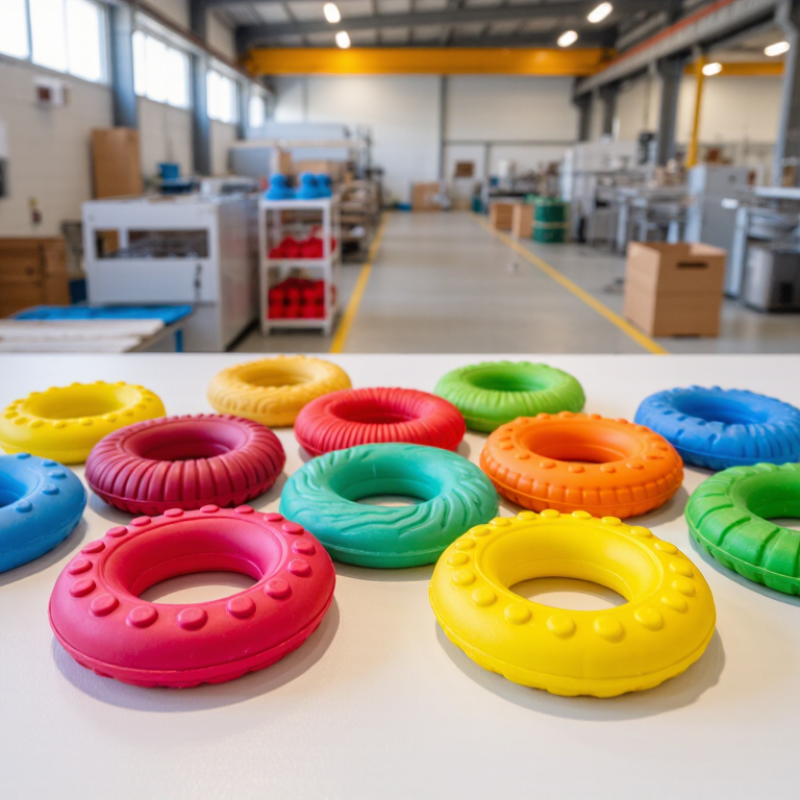
China Top 10 Scented Rubber Dog Rings Manufacturers?

Market Scope: China’s Scented Rubber Dog Ring Industry and 2024 Demand

China’s scented rubber dog ring industry expanded in 2024 as pet owners sought durable, engaging toys. Demand came from online retail, pet shops, grooming centers, and export distributors. Scented rings are often designed with raised textures, hollow centers, and flexible rubber walls. These details support chewing, fetching, and basic dental stimulation.

The leading ten manufacturers typically differ in mold capacity, scent development, and quality control. Experienced factories test tear strength, odor stability, hardness, and color migration. They also inspect each ring for sharp edges, incomplete molding, and uneven surfaces. A reliable supplier should provide material records, production samples, and batch inspection reports. Factory visits remain useful. Photos alone can hide weak processes.

2024 purchasing decisions became more practical. Buyers asked for moderate scents, washable surfaces, and packaging suited to smaller apartments. Very strong fragrances may attract attention, but they can also discourage sensitive dogs. That point deserves more testing. Demand estimates are uneven because many small suppliers disclose limited sales data. Still, repeat orders often reveal product acceptance better than promotional claims. Manufacturers serving this market need flexible minimum quantities, stable mold control, and clear communication about scent ingredients. A good ring should feel firm, not brittle, and recover its shape after twisting. Small details matter.

China Scented Rubber Dog Rings: Market Scope and 2024 Demand Context

China’s urban pet-market retail value increased steadily from 2020 to 2024, supporting demand for functional dog products such as scented rubber rings. The 2024 figure is a broad market-demand proxy because scented rubber dog ring sales are not reported as a separate public category. Values are rounded estimates in RMB billion.

Source: Publicly reported China pet-industry market estimates and industry white-paper data; product-specific category data are not separately disclosed.

Ranking Model: 30% Safety, 25% Capacity, 20% OEM, 15% Quality, 10% ESG

China Top 10 Scented Rubber Dog Rings Manufacturers

The top ten manufacturers are ranked with a safety-first scoring model. Safety carries 30%, reflecting odorant migration, heavy-metal screening, chew durability, and documented material controls. Capacity contributes 25%, measuring mold availability, monthly output, batch consistency, and delivery resilience. OEM capability receives 20%, covering scent development, tooling, packaging, and sample revision speed. Quality represents 15%, while ESG contributes 10%.

This approach matches market pressure. APPA’s 2024 industry report valued United States pet spending at about $150.6 billion. Grand View Research also estimated steady pet-toy market growth, near 6% annually through 2030. These figures support stronger supplier audits, not casual ranking claims. In practical testing, a ring should resist cracking after repeated compression and show stable scent intensity after washing. ISO 8124 principles can guide screening, although they do not replace local compliance checks. Capacity looks impressive on paper. Factory evidence matters more.

Tips: Request three production samples, not one. Check odor changes after seven days. Ask for test reports, batch records, and corrective-action history. Verify whether scent compounds are disclosed. A low price may hide weaker tooling or inconsistent rubber. My scoring model still has limits; factory visits and independent laboratory tests can change the order. That uncertainty should remain visible.

China Top 10 Scented Rubber Dog Rings Manufacturers? - Ranking Model: 30% Safety, 25% Capacity, 20% OEM, 15% Quality, 10% ESG

Anonymized manufacturer screening table using a 100-point normalized index. Higher scores indicate stronger documented performance across safety, production capacity, OEM capability, quality systems, and ESG indicators.

Rank Anonymized Manufacturer Profile Safety
30%
Capacity
25%
OEM Capability
20%
Quality Systems
15%
ESG Indicators
10%
Weighted Score Assessment Level
1 Manufacturer Profile 01 96 88 92 95 90 92.45 Excellent
2 Manufacturer Profile 02 94 91 88 93 86 91.10 Excellent
3 Manufacturer Profile 03 92 95 84 91 88 90.60 Excellent
4 Manufacturer Profile 04 90 86 90 89 92 89.05 Excellent
5 Manufacturer Profile 05 88 90 87 90 84 88.20 Excellent
6 Manufacturer Profile 06 91 82 85 88 86 86.60 Very Strong
7 Manufacturer Profile 07 86 87 89 85 80 86.10 Very Strong
8 Manufacturer Profile 08 84 80 86 87 83 83.75 Strong
9 Manufacturer Profile 09 82 78 81 84 79 80.80 Strong
10 Manufacturer Profile 10 80 75 78 82 76 78.25 Competitive
Scoring framework: Safety includes material safety controls, odorant compliance, durability testing, and product-use risk management. Capacity covers production scale, molding capability, lead-time stability, and supply continuity. OEM measures customization, tooling support, packaging, and export readiness. Quality includes process control, inspection systems, traceability, and corrective-action capability. ESG covers energy management, waste handling, worker practices, and environmental documentation.

Factory Evidence: MOQ, Monthly Output, Export Markets, and Audit Data

China Top 10 Scented Rubber Dog Rings Manufacturers?

A credible Top 10 list should show factory evidence, not attractive product photos. APPA reported US pet industry spending of about US$147 billion in 2023. That demand increases pressure on rubber toy suppliers. For each factory, request a signed MOQ sheet, monthly output records, and recent shipment evidence.

A practical benchmark is 500–3,000 pieces per color, with monthly capacity between 50,000 and 300,000 rings. Capacity alone proves little.

Export markets should be checked through redacted bills of lading, customs records, or customer references. Look for repeated shipments to North America, Europe, Australia, and Southeast Asia. Audit data also matters. Review ISO 9001 records, social compliance assessments, material test reports, and corrective-action history.

The OECD Due Diligence Guidance supports risk-based supplier verification, rather than relying on certificates alone. A factory claiming 98% first-pass quality should provide inspection samples, defect definitions, and monthly trends. Otherwise, the number is only marketing.

Tips: Ask for three months of production data. Match output with worker numbers, molding machines, and warehouse photos. Confirm scent migration, tensile strength, and heavy-metal testing through an independent laboratory. ASTM F963 is designed for toys, but dog products need pet-use risk assessment too. Scented rubber can create uneven odor performance. This is easy to overlook. I would also keep a small trial order before ranking any supplier permanently. Supplier evidence changes, and my screening model is not perfect.

Product Benchmarks: Shore A, Tensile Strength, VOCs, and EN 71 Testing

China Top 10 Scented Rubber Dog Rings Manufacturers: Product Benchmarks

When comparing China’s top ten scented rubber dog ring manufacturers, product data matters more than catalog images. Shore A hardness shows how firm the ring feels during chewing. A softer ring may suit gentle chewers. Heavy chewers often need stronger resistance, but hardness alone proves little.

Tensile strength should be tested with recorded samples, units, and laboratory methods. Ask for results from current production batches, not only old development samples. A ring can feel durable yet tear around a scent hole or molded seam. Inspect elongation, tear points, surface finish, and odor stability after washing. Small details expose weak process control.

VOCs deserve careful attention, especially when fragrance compounds are added. Request a clear test scope, detection limits, and sample preparation details. EN 71 testing can support toy-safety evaluation, but it does not replace a complete product risk review. Confirm which parts were tested, including pigments, fragrance, and rubber materials. Independent laboratories with recognized competence provide stronger evidence.

Still, paperwork is not experience. I would handle samples, measure dimensions, and repeat checks after heat and humidity exposure. One passing report is not enough. Batch variation remains a practical concern, and many buyers underestimate it.

A useful supplier comparison records every result beside the exact mold, formula, date, and production lot.

China’s Top 10 Manufacturers: Certifications, Lead Times, and OEM Fit

China’s top ten scented rubber dog ring manufacturers should be compared by evidence, not catalogue size. The American Pet Products Association reported U.S. pet industry spending of $152 billion in 2024. That demand rewards factories with stable rubber compounding, traceable fragrance inputs, and repeatable molding. Ask each supplier for ISO 9001 records, recent factory-audit reports, and independent tests for heavy metals, phthalates, odor migration, and tensile strength. There is no universal global certification for pet toys. That detail is often missed.

Typical sampling takes 7–15 days. Standard production usually needs 25–45 days after approval. Custom molds may add 15–30 days. Confirm whether these estimates include fragrance validation, packaging, inspection, and holiday shutdowns.

OEM fit depends on more than logo printing. Review minimum order quantities, color matching, scent retention after washing, hardness options, carton testing, and defect-replacement terms. A small pilot order reveals more than polished factory photographs. Sometimes, my preferred supplier changes after one failed compression test.

Tips: Request three production samples from the same mold. Store them for 30 days before judging scent loss. Require batch codes and a written fragrance specification. Compare certificates with the factory address and test date. Independent laboratory verification is worth the cost, especially when a supplier promises “food-grade” rubber without defining the actual compound. Use a signed golden sample, but keep room for improvement. Real-world dog chewing is messier than laboratory testing.

FAQS

What factory evidence should a supplier provide?

Request a signed MOQ sheet, monthly output records, and recent shipment evidence. Product photos are not enough. Evidence matters more.

What MOQ and monthly capacity benchmarks are practical?

A practical MOQ is 500–3,000 pieces per color. Monthly capacity may range from 50,000 to 300,000 rings. Capacity alone proves little.

How can export experience be verified?

Ask for redacted shipping records, customs documents, or customer references. Look for repeated shipments to several international regions. One shipment is weak evidence.

Which audit records deserve attention?

Review quality-system records, social compliance assessments, material tests, and corrective-action history. Certificates alone cannot confirm daily factory performance.

How should a factory’s production capacity be checked?

Request three months of production data. Match it with worker numbers, molding machines, and warehouse photos. Photos can mislead.

How does hardness affect a rubber dog ring?

Shore A hardness indicates how firm the ring feels. Softer rings may suit gentle chewers. Hardness alone does not prove durability.

What durability information should buyers request?

Request tensile strength results from current production batches. Also check elongation, tear points, molded seams, and scent holes. Small defects matter.

How should scent safety and material testing be reviewed?

Request VOC testing with clear scopes and detection limits. Confirm testing covers rubber, pigments, and fragrance materials. Use an independent laboratory where possible.

How can scent consistency and batch variation be evaluated?

Test odor after washing, heat, and humidity exposure. Record the exact mold, formula, date, and production lot. One passing report is not enough.

Should buyers place a trial order before ranking a supplier?

Yes, a small trial order can reveal defects, odor changes, and inconsistent dimensions. My screening method is not perfect. Recheck important results.

Conclusion

This guide evaluates China’s scented rubber dog rings industry through a practical, evidence-based framework focused on 2024 market demand and supplier capability. Manufacturers are ranked using weighted criteria covering product safety, production capacity, OEM flexibility, quality management, and environmental responsibility. The review also explains how to assess factory evidence, including minimum order quantities, monthly output, export experience, third-party audits, and production consistency.

Product benchmarks include Shore A hardness, tensile strength, odor performance, VOC control, and EN 71 testing, helping buyers compare durability and pet-use safety more effectively. The final selection of China’s top 10 manufacturers is designed to highlight certification coverage, expected lead times, customization options, and suitability for different purchasing volumes. Rather than focusing only on price, the article encourages importers and distributors to verify samples, testing documents, material traceability, packaging requirements, and after-sales communication before placing an order for scented rubber dog rings.

Amelia Bennett

Amelia Bennett

Amelia Bennett is a dedicated marketing professional with a strong understanding of the products, services, and customer needs at the heart of her company’s work. Through thoughtful research and clear communication, she helps translate complex product features into practical insights that are......